How to use the cello tuner
- Press Start tuner and choose Allow when the browser asks for the microphone.
- Tune the A string first. Bow it with slow, full strokes and even pressure, or pluck it. The A chip is marked “1st”.
- Follow the arrow and the coach. “↑ Tune up” means tighten, “↓ Tune down” means loosen. The line under the needle says whether to use the fine tuner or the peg.
- Work down through D, G and C. Give the C half a second to settle: low notes take the tuner a moment.
- Stop if a red warning appears. It means the string is well above its note.
Tap a chip to lock the tuner to one string. With the tuner focused, keys 1 to 4 lock C, G, D and A, and 0 goes back to automatic.
Cello string notes and frequencies
Face the cello with the scroll at the top. From left to right the strings are C, G, D and A, from the thickest and lowest to the thinnest and highest. The cello is tuned in fifths, one octave below the viola.
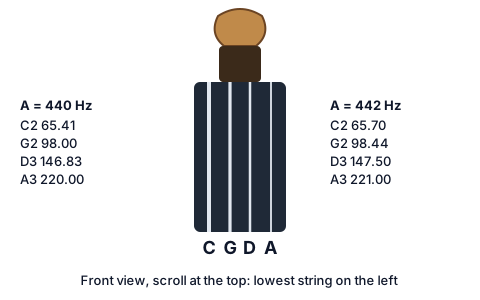
| String | Note | A = 440 Hz | A = 442 Hz |
|---|---|---|---|
| 4th (lowest) | C2 | 65.41 Hz | 65.70 Hz |
| 3rd | G2 | 98.00 Hz | 98.44 Hz |
| 2nd | D3 | 146.83 Hz | 147.50 Hz |
| 1st (highest) | A3 | 220.00 Hz | 221.00 Hz |
Every size of cello, from 1/10 to full size (4/4), uses the same four notes. Many orchestras tune to A = 442: press the 442 chip, or set any value from 415 to 466 Hz.
Getting a steady reading on the low C
This online cello tuner listens through your microphone, and the low C is the hardest string for it. Many phone and laptop microphones pick up little sound below about 100 Hz, so the C (65.41 Hz) arrives mostly as its overtones at 131 Hz, 196 Hz and up. The tuner checks each reading against the cello’s strings and moves it down an octave when the C fits better. It listens to about 85 ms of sound at a time, enough for five cycles of the C, and shows “Listening to the C string…” while the reading builds.
For a steadier reading:
- Put the phone about an arm’s length in front of the cello, facing the f-holes.
- Keep the bow speed steady, with the contact point about halfway between the bridge and the fingerboard.
- Pluck the string if the reading still wobbles. A plucked note is cleaner.
- Stop the endpin from rattling on a hard floor with an endpin stop. A rattle adds noise.
Pegs, fine tuners and the seasons
Cello pegs grip only when you press them into the pegbox while you turn. Turn a little, press in, and pluck to check. A peg that isn’t pushed in slips back as soon as you let go.
Fine tuners are the small screws on the tailpiece. Clockwise raises the note, counterclockwise lowers it. Many student cellos have four, one per string. Many advanced players keep only one, on the A string. Set “Fine tuners on” to match your cello, and the coach suggests the fine tuner for small errors (up to about 30 cents) and the peg for bigger ones.
The seasons matter too. In dry winter air the wood shrinks, so pegs loosen and slip. In humid summers it swells, so pegs stick and jump. If a peg keeps slipping or won’t turn, take the cello to a luthier rather than forcing it. Geared pegs, which look like ordinary pegs but turn smoothly and hold their place, are a common fix.
Pure or tempered fifths on the cello?
Many cellists tune the A from the tuner or the oboe, then tune D, G and C by ear with double stops: bow two strings together and turn until the beats (the wobble) stop. That makes each fifth pure, about 2 cents wider than on a piano.
Three pure fifths add up. Tuned by ear from A, the D ends about 2 cents below an equal-tempered tuner, the G about 4 cents below and the C about 6 cents below (65.19 Hz instead of 65.41 Hz). On its own that sounds fine, but it stands out against a piano’s low C.
Choose Pure when you play with other strings and tune by ear, so the tuner agrees with your ear. Choose Equal-tempered next to a piano or an organ. In By ear mode, the Fifths helper drones one string (A, then D, then G) while you bow the next. The violin tuner uses the same method.
Bach Suite No. 5 and other notes
Bach’s Suite No. 5 in C minor asks for scordatura: the A string tuned down a whole step to G3. Choose Bach Suite No. 5 in the Tuning menu, and the tuner reminds you to lower the A string and to tune it back afterwards. With two G strings, the tuner tells them apart by their octave.
Wolf tones are another surprise. Many cellos have one note, often somewhere between E and F♯ on the G string, that wobbles or growls when you bow it. It comes from the body’s resonance, not from the tuning, so the tuner can’t fix it. A luthier can fit a wolf eliminator.
For a double bass, use the bass tuner, which has orchestral and solo presets. To hear a reference pitch first, play a steady 220 Hz tone from the tone generator: that’s the cello’s A string.