How to use the ukulele tuner
- Press Start tuner and choose Allow when the browser asks for the microphone.
- Pick your tuning. Keep Standard unless you know your ukulele has a low G, is a baritone, or your songbook uses D tuning.
- Pluck one string and let it ring. The strip highlights the string the tuner heard.
- Follow the arrow. “↑ Tune up” means tighten the peg, “↓ Tune down” means loosen it. If the hint says you’re moving away from the note, turn the peg the other way.
- Repeat for all four strings. Each one gets a ✓ after half a second in tune, and the panel says so when all four are done.
- New strings? Play for 2 minutes, then press Re-check. They will have dropped a little.
Tap a string to lock the tuner to it, which helps when a string is far off. With the tuner focused, keys 1 to 4 lock string 1 (A) to string 4 (G), and 0 goes back to automatic.
Ukulele string names and order (for beginners)
Hold the ukulele as if to play it. String 4 is the one nearest your face, string 1 the one nearest the floor. From 4 to 1 they are G, C, E and A.
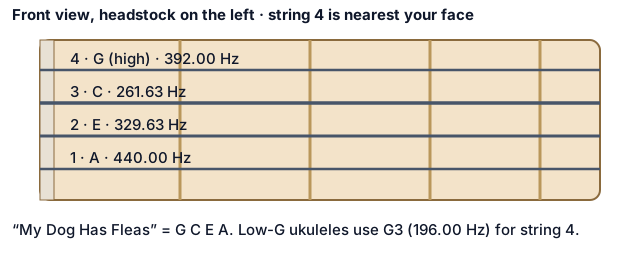
| String | Note | Frequency (A4 = 440 Hz) |
|---|---|---|
| 4 | G4 (high G) | 392.00 Hz |
| 3 | C4 (middle C) | 261.63 Hz |
| 2 | E4 | 329.63 Hz |
| 1 | A4 | 440.00 Hz |
Many teachers use the line “My Dog Has Fleas” to remember the order and the sound: sing it while plucking 4, 3, 2, 1.
You’ll notice string 4 sounds higher than string 3, even though it sits on top. That’s re-entrant tuning: the G jumps back up instead of continuing down. It keeps all four notes close together, which gives the ukulele its bright, chiming strum. The tuner marks that chip “G · high” so you don’t tune it an octave too low.
Soprano, concert, tenor and baritone tunings
The size of a ukulele doesn’t change its tuning, except for the baritone.
| Ukulele | Tuning | Notes |
|---|---|---|
| Soprano, concert, tenor | G C E A (Standard) | The usual high G |
| Soprano, concert, tenor | G C E A (Low-G) | String 4 is G3, 196.00 Hz, with a thicker string; common on tenors |
| Baritone | D G B E | The same notes as a guitar’s top four strings |
| Older songbooks | A D F♯ B (D tuning) | Everything one whole step higher than Standard |
A low-G ukulele needs a low-G string. Don’t just slacken a high-G string by an octave: it will flop and buzz. A bass ukulele is tuned E A D G, the same notes as a bass guitar and far below this page’s range, so use a bass tuner instead.
How the ukulele tuner works
This online ukulele tuner listens through your microphone, takes about 20 measurements a second, and compares each note with the four strings of the tuning you chose. No app is needed. It shows the nearest string, how many cents sharp or flat you are, and which way to go.
The uke tuner also listens for the wrong preset. If it hears a clear, steady G3 while Standard is selected, it asks whether you have a low-G ukulele; a D3 suggests a baritone. You can switch with one tap or dismiss it for the session.
It can’t read chords: a strum contains four pitches at once. Pluck one string at a time. Clip-on tuners work differently. They sense the vibration through the headstock, so they ignore room noise, which is why they’re handy at a jam.
Getting a clean reading from your microphone
- Hold the phone 20 to 40 cm from the sound hole.
- Find a quiet room. Turn off fans and the TV.
- Pluck with the flesh of your thumb for a clean, steady note.
- Rest a finger lightly on the other strings so they don’t ring along.
- If the level bar stays low, test your microphone to check that the right input is selected.
Why your ukulele won’t stay in tune
New strings stretch. Nylon and fluorocarbon strings keep stretching for several days, and in the first hour they can go noticeably flat within minutes. Re-tune often. To speed things up, tune to pitch, then gently pull each string a few centimeters away from the fretboard along its length, and tune again. Repeat three or four times.
Friction pegs slip. Many cheaper sopranos have friction pegs held by a small screw in the end of the button. If a string keeps falling flat after the first week, tighten that screw a quarter turn so the peg holds without being hard to turn.
Temperature and humidity change the wood and the strings. A uke that was in tune in a cold car will go sharp or flat in a warm room. Let it settle for 10 minutes, then tune.
Tune up to the note, not down to it. If a string is sharp, loosen it a little below the note and bring it back up. That leaves the string wound tightly around the peg so it doesn’t slip back.
Tuning a ukulele by ear
Choose By ear to hear reference tones. Tap a string to hear it for 4 seconds, or press Play all (or P) to hear G, C, E and A in turn. Start with your device volume low.
You can also tune the strings to each other, once one string is right:
- Press the C string (3) at the 4th fret: that’s E. Tune string 2 to match.
- Press the E string (2) at the 5th fret: that’s A. Tune string 1 to match.
- Press the C string (3) at the 7th fret: that’s G. Tune the high G (4) to match.
- On a low-G ukulele, press the G string (4) at the 5th fret: that’s C, the note of string 3.
Other instruments and tunings? The chromatic online tuner names any note.