How to use the mandolin tuner
This free mandolin tuner runs online, with no download.
- Press Start tuner and choose Allow when the browser asks for the microphone.
- Pluck one string of a pair and let it ring. Rest a fingertip lightly on the other string of the pair so it stays quiet.
- Follow the arrow. “↑ Tune up” means tighten, “↓ Tune down” means loosen. The pair gets a ✓ after half a second in tune.
- Turn on Pair check (or press P) to compare the two strings of each pair: pluck string 1, then string 2, and read the result.
- Repeat for all four pairs. With Pair check on, the panel says your mandolin is in tune when every pair has two filled dots.
If the microphone is blocked, choose Tune by ear and tap a pair to hear its note.
Mandolin tuning: G D A E in pairs
A mandolin has eight strings in four pairs, called courses. Both strings of a pair are tuned to the same note (a unison), which gives the mandolin its bright, ringing sound.
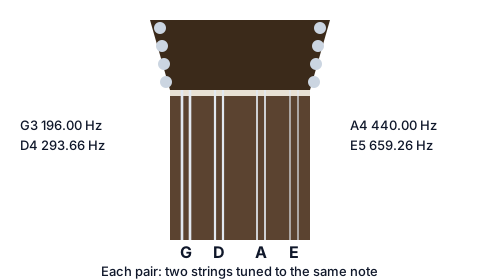
| Pair | Note | Frequency (A4 = 440 Hz) |
|---|---|---|
| 4th (lowest) | G3 | 196.00 Hz |
| 3rd | D4 | 293.66 Hz |
| 2nd | A4 | 440.00 Hz |
| 1st (highest) | E5 | 659.26 Hz |
These are the same notes as a violin, and like a violin, each pair is a fifth above the one before. A mandolin is tuned like a violin, so the violin tuner uses the same four targets.
How to tune the string pairs
Two strings that are almost, but not quite, the same pitch produce beats: a slow, regular wobble in the volume. Strings 4 cents apart on the G pair beat about 0.45 times a second. On the E pair, 3 cents apart beats about 1.1 times a second. A little of this sounds like a chorus effect, but more sounds sour.
Tune string 1 of a pair to the tuner, then string 2, then listen to both together. The Pair check measures each string, shows how far apart they are in cents and beats per second, and tells you which string to retune:
- Matched (2 cents or less): you won’t hear a wobble.
- Close (2 to 5 cents): a slight shimmer.
- Mismatched (more than 5 cents): a clear warble. Retune the string that’s further from the note.
To check by ear, press each pair at the 7th fret: it sounds the same note as the next pair up, open. G at the 7th fret is D, D at the 7th is A, and A at the 7th is E.
Can you use a guitar tuner on a mandolin?
Yes, if the tuner is chromatic and names any note. Look for G3, D4, A4 and E5.
A guitar-only mode expects E A D G B E and may name the nearest guitar string instead of the mandolin note. Only the G pair is the same note as a guitar string (the open G). D4 is a whole step below the guitar’s high E, and A4 and E5 are higher than any open guitar string, so a guitar mode may show them in the wrong octave.
Ukulele tuning is a different system again: G C E A, not stacked fifths. For a ukulele, use the ukulele tuner.
Alternate tunings and the mandolin family
Fiddle players retune the mandolin for some old-time tunes:
- AEAE: raise the G pair to A and the D pair to E, each a whole step.
- GDGD: lower the A pair to G and the E pair to D, each a whole step.
Retune slowly and come back to GDAE after the set.
The rest of the family uses the same layout an octave or a fifth lower:
| Instrument | Tuning | Lowest note |
|---|---|---|
| Mandola | C3 G3 D4 A4 | 130.81 Hz |
| Octave mandolin (octave mandola in Europe) | G2 D3 A3 E4 | 98.00 Hz |
| Mandocello | C2 G2 D3 A3 | 65.41 Hz |
Low notes take the tuner a moment longer, so let the string ring. Phone microphones pick up little of the mandocello’s low C fundamental, but the tuner can read the overtones.
Checking the floating bridge
A mandolin’s bridge isn’t glued: string pressure holds it in place. It can shift when you change strings, which throws the notes higher up the neck out of tune even when the open strings are perfect. Change one string at a time so the bridge stays put.
The Bridge check compares two notes on one pair. First, play the 12th-fret harmonic (touch the string lightly right above the 12th fret and pluck). Then press the string down at the 12th fret and pluck again. Both should be the same note.
- Fretted note sharp: move the bridge slightly toward the tailpiece.
- Fretted note flat: move the bridge slightly toward the neck.
Check the lowest and highest pairs. If they point in opposite directions, angle the bridge slightly instead of moving it. Loosen the strings a little before you nudge it.
Mandolin tuners: the tuning machines
“Mandolin tuners” also means the geared tuning machines on the headstock. They usually come as sets of four on a shared plate for each side. Sets for A-style and F-style mandolins differ in plate shape and layout, so check with the maker which set fits your headstock.
Signs that machines are wearing out:
- A string slips flat even though the button doesn’t turn.
- A button turns stiffly, or has a tight spot every revolution.
- A button wobbles. Often the small screw in its end has loosened: tighten it a little.
Before you buy replacements, measure the spacing between the string posts and compare it with the set’s specifications.
For other instruments, use the chromatic online tuner. Playing in a bluegrass band? The banjo tuner handles the banjo’s short 5th string and capo.